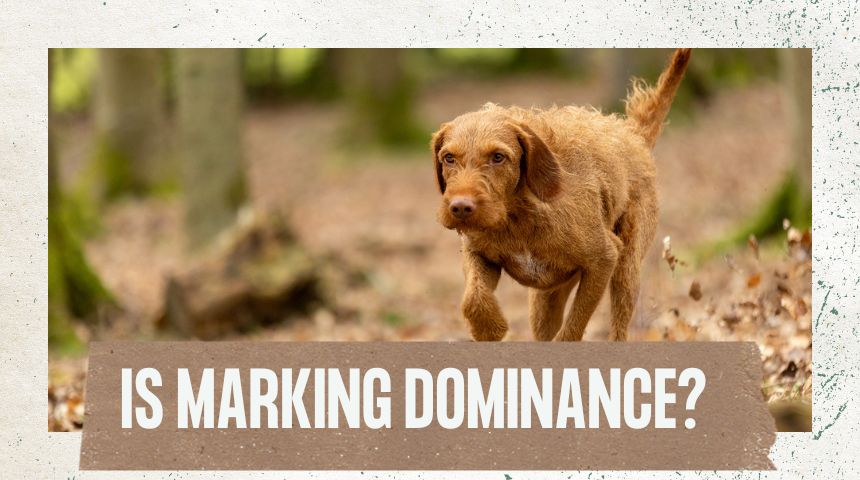
Is marking dominance?
Is Marking Really Dominance? Understanding Displacement Behaviours in Gundogs
One of the most common pieces of advice I still hear in the gundog world is:
"He's marking because he's dominant."
Usually followed by suggestions that the dog needs a stronger correction or to be shown who's boss.
The problem is that behaviour is rarely that simple.
Whilst some dogs do develop habits around scent marking, many cases of marking during training have far less to do with dominance and far more to do with how the dog is feeling emotionally.
And it's not just male dogs.
Female dogs can display exactly the same behaviour.
What Is a Displacement Behaviour?
A displacement behaviour is something a dog does when they are experiencing an internal conflict, stress, uncertainty, anxiety, or pressure.
Common displacement behaviours include:
Excessive sniffing
Scratching
Shaking off
Suddenly becoming interested in the environment
Wandering away from the task
Marking
Think of it as the dog's way of saying:
"I'm not quite sure how to cope with this situation right now."
Rather than dealing directly with the challenge in front of them, they perform another behaviour instead.
The Story of Nye
Recently I worked with a young black Labrador called Nye.
Nine months ago, he showed enormous promise. He achieved a Distinction in his Grade 4 assessment and looked like a dog with a bright future ahead of him.
Then he became seriously ill.
The illness affected him physically, but it also affected him emotionally.
Nye is a sensitive dog and after recovering, his confidence disappeared.
The confident youngster who had once attacked retrieves with enthusiasm began to hesitate.
At times he wouldn't even run out for a simple marked retrieve.
Around the same time, he also began marking during training.
Some people might have looked at that behaviour and concluded that he needed stricter handling.
But what I could see was something very different.
I wasn't looking at a dog trying to challenge authority.
I was looking at a dog who lacked confidence and was struggling with the pressure he felt.
The marking wasn't the problem.
It was a symptom.
Looking Beyond the Behaviour
One of the biggest mistakes we can make as trainers is focusing entirely on stopping a behaviour without understanding why it is happening.
If we only look at the marking, we miss the bigger picture.
The real questions are:
Is the dog confident?
Is the dog worried?
Has something changed recently?
Is the dog finding the exercise too difficult?
Is there a physical issue involved?
Is the dog feeling pressure from the environment or handler?
When we ask better questions, we often find better answers.
Helping the Handler Read the Dog
One of the challenges for novice handlers is learning how to read their dog.
Nye's owner, Mike, had never been through anything like this before.
To his credit, he never gave up.
Together, we worked on simplifying the training, reducing pressure, rebuilding confidence, and helping Mike understand what Nye was telling him.
Instead of trying to force performance, we focused on creating success.
Instead of worrying about where Nye had been, we focused on where he was now.
Gradually, things began to change.
The Turning Point
During a recent five-day holiday, we saw a remarkable transformation.
Day by day, Nye's confidence grew.
The retrieves improved.
The enthusiasm returned.
Most importantly, he looked happy again.
And something else happened.
The marking disappeared.
Not because anyone punished it.
Not because we corrected it.
But because the underlying cause had been addressed.
The dog no longer felt the need to perform that behaviour.
Confidence Changes Everything
One of the most rewarding moments as a trainer is seeing a dog rediscover their confidence.
When confidence returns:
Performance improves
Learning improves
Problem-solving improves
Enjoyment improves
Many unwanted behaviours reduce naturally because the dog is no longer struggling emotionally.
This doesn't mean every marking dog is anxious.
Nor does it mean every behaviour issue can be solved by boosting confidence alone.
But it does mean we should resist jumping to conclusions.
Before You Correct, Ask Why
Whenever I see a dog marking repeatedly during training, my first question isn't:
"How do I stop it?"
My first question is:
"Why is it happening?"
Because behaviour is information.
The dogs are constantly communicating with us.
The more skilled we become at listening, the better trainers we become.
Sometimes the answer is training.
Sometimes the answer is management.
Sometimes the answer is a veterinary check.
And sometimes, as with Nye, the answer is simply helping a dog feel safe, confident, and happy enough to enjoy the job again.
For me, that is one of the most important lessons any gundog trainer can learn.
Before correcting the behaviour, understand the reason.


