
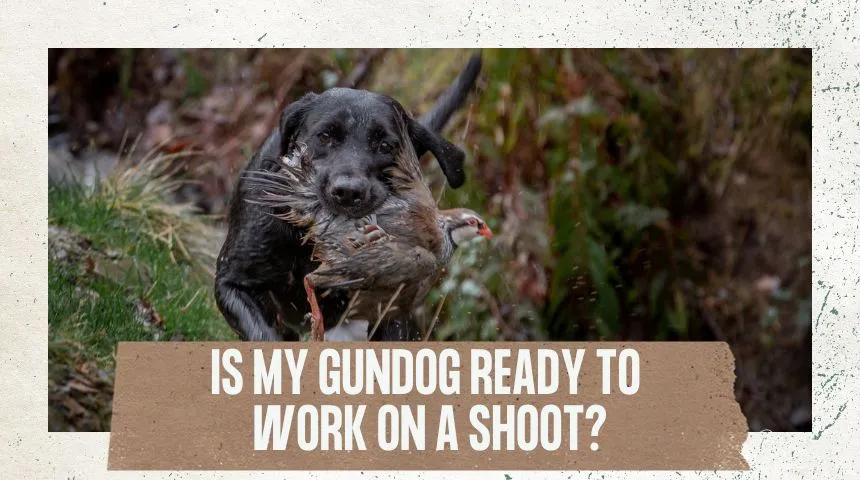
Is Your Gundog Really Ready for Its First Shoot Day?
Is Your Gundog Really Ready for Its First Shoot Day?
Preparing your dog for the excitement, distractions and challenges of the shooting field.
There's something incredibly exciting about taking your gundog out on a shoot for the first time.
You've spent months, perhaps years, training. Your dog can retrieve, respond to the whistle, walk reasonably well at heel and remain steady around distractions.
But does that mean they're ready for the shooting field?
Not necessarily.
A shoot day is a very different environment from a training session. The sights, sounds, smells and sheer excitement can be overwhelming, even for a dog that performs beautifully in training.
And sometimes the very behaviours we interpret as disobedience are simply a dog struggling to cope with everything that's happening around them.
So how do we know when our dogs are genuinely ready?
1. Training behaviours and emotional readiness are not the same thing
It's easy to focus on the practical skills our dogs need.
Can they sit to the flush? Can they recall reliably? Will they deliver a retrieve to hand? Can they walk at heel?
These are all important foundations, but there's another question we should be asking.
Can my dog still think, listen and respond when the environment becomes incredibly exciting?
A dog might be perfectly steady around a thrown dummy in a familiar training field but find it almost impossible to remain still when birds are flying, guns are firing and other dogs are working.
That's not necessarily because the dog has forgotten its training.
The environment has changed, and so has the dog's emotional state.
Excitement, frustration, anticipation and uncertainty can all influence behaviour.
If we want our dogs to succeed, we need to prepare them for those feelings as well as the practical tasks.
2. Build your foundations before introducing the excitement
Before considering a shoot day, I'd want to see some reliable foundations in place.
These include:
A recall that works around meaningful distractions.
The ability to remain settled while other dogs work.
A positive, confident retrieve and delivery.
An understanding of stop and directional cues appropriate to the dog's role.
The ability to walk calmly with the handler.
Confidence around unfamiliar people, dogs, noises and environments.
But I wouldn't just test these behaviours in the same familiar training field.
I'd gradually introduce new locations, different dogs, unfamiliar situations and increasing levels of excitement.
The important word here is gradually.
We want dogs to learn that they can still respond and make good choices when things become exciting, rather than discovering on their first shoot day that everything is suddenly much harder.
3. Don't underestimate the effect of other dogs
One of the biggest surprises for handlers attending their first shoot is how much their dog's behaviour can be influenced by the dogs around them.
Imagine your dog sitting quietly beside you.
Another dog suddenly runs in after a bird.
Your dog sees the movement, hears the excitement and decides to join in.
It can happen remarkably quickly!
Dogs don't work in isolation, and movement can be an incredibly powerful trigger.
That's why training alongside other dogs is so valuable.
Practise watching other dogs retrieve, hunt and move around while your own dog remains engaged with you.
And remember, the aim isn't simply to prevent your dog from moving. It's to help them develop the emotional skills to cope with watching exciting things happen without needing to join in.
4. Introduce gunshot carefully
Being comfortable with gunshot is obviously an important part of working on a shoot.
But gunshot introduction shouldn't be rushed.
Ideally, dogs should develop a positive association with the sound through carefully planned, gradual exposure at an appropriate distance.
We want a dog that hears a shot and remains confident, not one that is frightened, startled or overwhelmed.
It's also worth remembering that a dog that appears comfortable with occasional shots during training may react differently when multiple guns are firing, birds are falling and excitement is building.
If your dog shows signs of concern around gunshot, don't assume that more exposure will solve the problem.
Take a step back and seek appropriate support.
5. Is your dog ready for cold game?
For many young gundogs, their first experience of cold game is a significant step in their training.
A canvas dummy and a real bird are very different things.
The smell, texture, weight and feel can all affect how a dog responds.
Some dogs pick up game confidently straight away. Others hesitate, investigate, become overexcited or struggle to deliver.
None of these responses automatically tells us that a dog is being difficult.
They're giving us information about how they're experiencing something new.
I'd always prefer to introduce cold game in a calm, supportive training environment rather than leaving that first experience until a busy shoot day.
That gives us the opportunity to build confidence, develop a comfortable hold and delivery, and work through any difficulties without unnecessary pressure.
Want help making the transition from dummies to game?
Our Cold Game Workshop on 5–6 December, with Gemma Cox at Completely Gundogs in Mid Wales, is designed to help handlers develop their dog's confidence and skills when working with cold game.
[Find out more about the Cold Game Workshop]
6. Your dog's first shoot doesn't need to be a full working day
This is probably one of the most important pieces of advice I can give.
Just because your dog is going to a shoot doesn't mean they need to work all day.
In fact, for many dogs, I'd much rather their first experience was a short, carefully managed introduction.
Perhaps they accompany you for part of the day, watching from a suitable distance where they can remain comfortable and relaxed.
Perhaps they have a very small amount of work to do in a situation you know they can manage.
Or perhaps they don't work at all.
A successful first shoot day doesn't have to involve picking up a single bird.
It might simply involve your dog experiencing the environment, remaining confident and going home having had a positive experience.
There's plenty of time to develop the working skills later.
7. Know when to give your dog a break
We often talk about dogs becoming overexcited, but we don't always recognise the early signs.
A dog that starts whining, pulling, scanning constantly, struggling to settle or becoming less responsive may be telling us that the situation is becoming too much.
Some dogs become frantic. Others become quieter or hesitant.
Neither response should automatically be interpreted as disobedience.
Instead of repeatedly asking for behaviours that your dog is struggling to perform, consider whether they need more distance, a quieter environment or a break.
And sometimes the kindest and most productive decision is to finish for the day.
There's no shame in that.
In fact, recognising when your dog has reached their limit is an important part of good handling.
8. Don't be in a rush to get your dog out shooting
I understand the excitement of wanting to see your training come together in the shooting field.
But there's no deadline.
A dog that starts working a little later, with stronger foundations and greater confidence, is far more likely to enjoy the experience and develop into a reliable working companion.
Rushing can create problems that take considerably longer to resolve than the time we might have saved.
Remember that every dog develops at a different pace.
Rather than asking whether your dog is old enough to go shooting, ask whether they have the skills, confidence and emotional readiness to enjoy the experience.
Preparing your gundog for the future
Whether your ambition is to pick up, beat, work on a walked-up shoot or simply enjoy developing your dog's natural abilities, good preparation makes all the difference.
At Completely Gundogs, we focus on helping handlers understand not just what their dogs are doing, but why.
Because when we understand the emotions influencing behaviour, we can make better training decisions.
If you're just beginning your gundog training journey, our online courses can help you develop those essential foundations at your own pace.
Puppy to Picking Up Dog– for handlers wanting to develop their puppy towards becoming a confident, capable working gundog.
Beginner Guide to Working Your Dog on a Shoot – a starting point for building essential gundog training skills.
And if your dog is ready to begin the transition to game, we'd love to welcome you to our Cold Game Workshop on 5–6 December.
[Book your Cold Game Workshop place]
The aim isn't simply to produce a dog that can work on a shoot. It's to develop a dog that is confident, capable and genuinely enjoys being there.
Collette May
Completely Gundogs – Positive Reinforcement Gundog Training in Mid Wales


